2021 Archives
TenantSee Weekly
Not 2001…
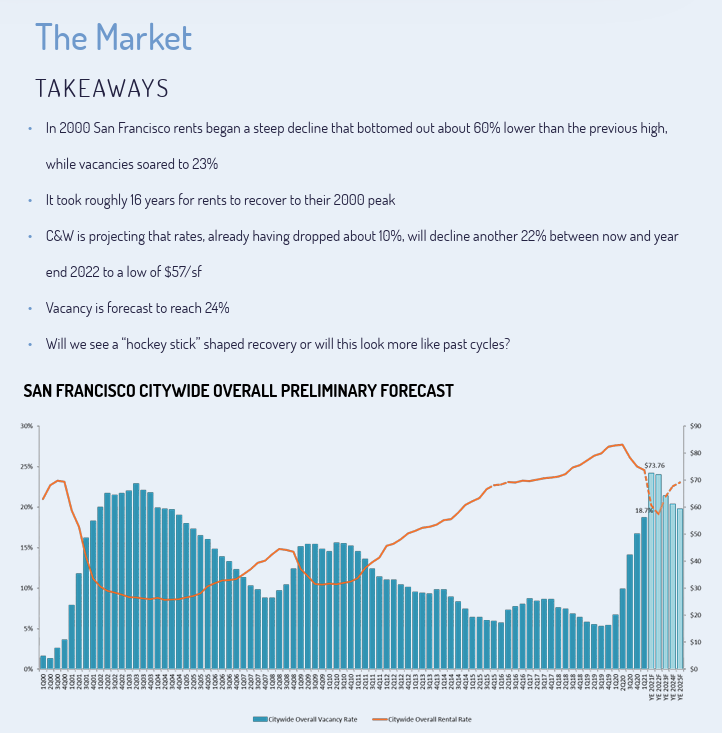
The last time San Francisco office vacancy hit 20% was 2001. Asking rents dropped by more than 60% in the early 2000s. As of 2Q 2001, overall vacancy is 20.1%. This is up from about 4% in 1Q of 2020. Yet Asking rents for direct space are down only ~10% from their pre-pandemic high. Why?
Firstly, 45% of overall vacancy is sublease space. Landlords have yet to feel the pain of the pandemic. Rent collections and occupancy levels within their assets have remained high, buying them time to avoid competing in a down market. Secondly, landlords are being strategic about when and where to lower rates. They are (mostly) choosing to let the competition for tenant demand play out in the sublease market, betting that in 2-3 years when many of the subleases have gone away (the weighted average remaining term of all sublease space is ~3 years), demand will have sufficiently recovered to mitigate rental declines in the direct space market.
In contrast, in 2001, landlords felt immediate pain because many of their tenants went into bankruptcy and handed back the keys to the space. This caused direct asking rents to begin a steep (and rapid) decline as landlords sought to shore up vacancy and get ahead of falling rates.
While landlords may be able to come out the other side of this with comparatively limited damage, tenants seeking to sublease space can’t avoid competing heavily for subtenants, as the value of space having 3 years or less of remaining term generally declines as the expiration grows nearer. Unlike in 2001, for the time being, this downturn has afforded landlords the luxury to bet on a brighter future.
Where Do I Sit?
Coworking, hoteling, benching, cubicles, private offices, phone booths, all-hands and collaboration space, game rooms, food service, sit/stand desks, hybrid, remote, exercise facilities, outdoor space, technology…the way we work has been rapidly changing for the past decade. The pandemic merely accelerated these changes.
Yet deciding how and where employees work is more complicated than ever. Establishing the workplace has always been, at least partly, a leap of faith. Will our talent revolt if we introduce benching? Will our top professionals balk if we move their private offices from the window line to the interior? Do we need to invest in sit/stand desks? Should we have a satellite office close to where our employees live? Endless decisions. And the choices can have a big impact on employee recruitment and retention. There’s a lot at stake.
In our experience, it’s important for companies to be intentional and thoughtful with workplace decisions. Employers should engage employees in designing and implementing workplace strategies. But many companies seek to avoid giving the employees a say in the matter. The common thinking is, “we don’t want to give them the sense they have power to dictate how they work and/or how we establish the workplace because we may not agree with their ideas and/or be able to meet their demands”. This is understandable. However, it’s a mistake. The conversations should take place. The employees should have a voice. But it should be a guided/managed discussion, infused with transparent understanding that it’s rarely a “blank slate” and there are limitations to what can be accomplished. This level of engagement sends a clear message that the employer cares about its employee experience and truly wants to get it right. Messaging is a big part of any workplace strategy. Afterall, office space is a huge investment made for the benefit of the employees and the company. It’s a wasted opportunity when the benefits of this investment are not clearly communicated across the organization.
We’re in a time of extreme workplace change. It’s important to manage this change intelligently and remember that every company is different. For most, it will also be smart to proceed with caution and not look to be an early adopter of extreme strategies (e.g., fully remote). It’s a safe bet that as the effects of the pandemic dissipate and we return more fully to the habits of our pre-pandemic lives, the nature of the office will also revert to more closely resemble the fall of 2019 than the spring of 2020.
High Vacancy, Limited Options
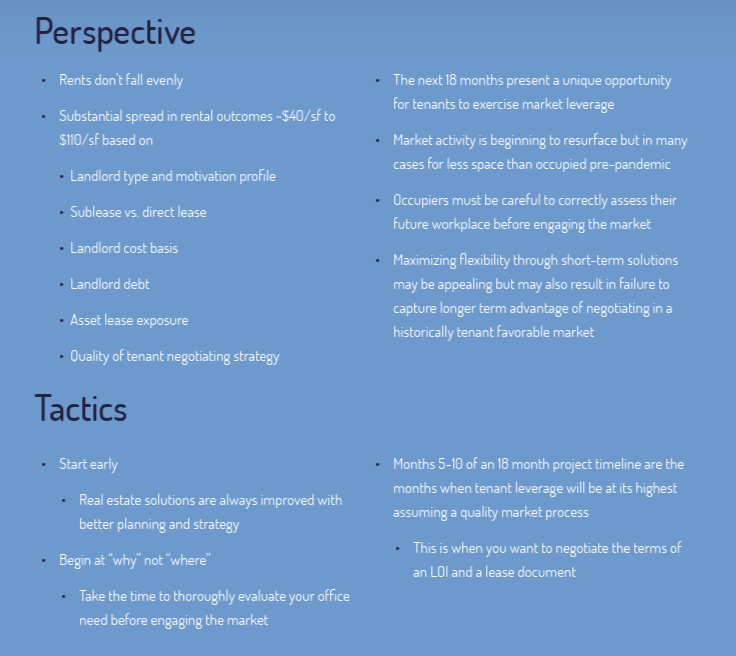
With all the news about the high vacancy rate and ongoing uncertainty around return to office, companies beginning to explore the San Francisco office market expect to select from a wide range of site options and to realize substantial savings over their pre-pandemic lease costs. Yet for tenants seeking certain types of space, the market experience is decidedly different, characterized by limited options and relatively modest levels of landlord concessions. Why?
Bigger is Better
Landlords prefer full floor tenancies. Average tenant size in San Francisco has grown considerably over the past 15 years with the surge in tech sector demand. As a result, landlords have been able to avoid the cost of demising single floors to accommodate multi-tenant occupancy. Average floor size in San Francisco is about 20,000 sf. The overall effect is fewer space options for occupiers seeking spaces from 3,000 to 15,000 sf.
Less is More
Professional service companies still use private offices. But the availability of prebuilt professional service space is low. This is because landlords have positioned their buildings to attract technology companies who prefer mostly open space. The result is an abundance of 2nd generation tech/open space and a shortage of 2nd generation professional service space.
Flight to Quality
In every downturn, tenants look to “trade up” to higher quality space. This has the effect of creating out-sized demand in a relatively small segment of the supply, causing rental economics in these segments to be less soft than the in the overall market.
Sublease vs. Direct
A large portion of total supply is sublease space. Until this supply begins to substantially lease at discounted rates putting pressure on direct landlords and/or converts to direct vacancy (e.g., becomes a landlord’s problem) its impact on direct space pricing will be muted. Add to this the fact that some companies are electing to pull sublease space from the market in favor of keeping if for their own occupancy.
Ultimately, if demand remains soft and there is an aggregate reduction in occupier space need, landlords will respond by demising floors and becoming more competitive with rental economics, in particular, addressing the high cost to building professional office space (which has increased, not decreased during the pandemic). But for some, the realities of the existing market dynamic will be disappointing relative to their expectations of post-pandemic negotiating leverage.
Creatures of Habit
Habits dictate so much of our behavior. This past week I’ve been returning to my office. Cushman & Wakefield has a beautiful office on the 23rd floor of a downtown high-rise. My personal space there affords me a view of the San Francisco bay. I have every reason to rush back to the office – not the least of which is that helping companies lease office space is my business.
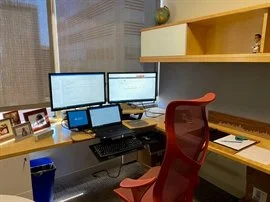
My Downtown Office
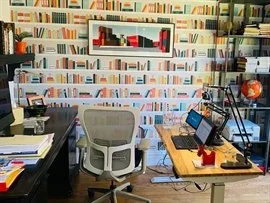
My At-Home Office
Yet my habit for the past year+ has been to work from home. And, to be honest, it hasn’t been horrible. I’m fortunate to have a set up that is conducive to work. The biggest difference is what happens in the mornings as we prepare to get the kids to school, walk the dog and (now that I’m going back to the office) shower and put on real clothes. The mornings become more chaotic. Of course, my dog can’t come to the office with me - - - he has enjoyed sleeping at my feet while I work.
Humans are habitual. And we often seek to avoid change. I wonder how much of the angst around return to office will simply go away once we’ve been back for a couple of weeks. In fairness, we changed a lot about how we spend our days. I bet many of us will rediscover the benefits of being together with our colleagues and being at work, away from home. While there’s been elements of work from home that have been positive, I confess to struggling to create balance and separation between work and home life. There’s a feeling that work never ends; whereas when you physically go to the office to work and then leave to go home, you get that separation, both physical and mental.
I choose to look at this as a learning opportunity that is going to positively reshape how and where people work. But one of the insidious aspects of technology is how it enables us to work from anywhere, all the time. Regardless of where we choose to work, we must have the ability to “turn off” our work and disconnect. This is increasingly challenging, perhaps even more so after this past year.
How to Plan a Hybrid Workplace
For over a year, most companies have survived with limited or no use of their office space. Now that the pandemic is beginning to subside in the US, office occupiers are planning a return to office. Many are planning to modify elements of their space usage to meet the changing demands of their employees. The most common approach is the hybrid office where in employees have the flexibility to use the office on a periodic basis to fulfill specific work-related needs. In the hybrid office, employees can choose to gather for team collaboration, for culture building or client facing events/meetings and to secure quiet "head down" space for work they may not be able to accomplish at home. On the other hand, employees have the flexibility to choose to work from home or remotely at least some of the time.